Free email plans tend to hit their limit on the worst possible day — usually when something's actually happening. New signups to onboard, a launch going out, a campaign already queued. You upgrade under pressure and pay whatever shows up first on the pricing page.
Most sending emails service free tier options are built around a simple premise: let you invest enough time building workflows and importing contacts that switching feels painful — then squeeze. The free plan isn't a product. It's a trap with a countdown timer.
But not all of them. Some platforms have free tiers that are genuinely built for early-stage teams to grow on. Here's how to tell the difference, and which ones are actually worth your time in 2026.
The free email tier lie: what platforms don't advertise
The pattern is consistent: advertise a generous-sounding number on the pricing page, then bury the restrictions that make that number meaningless.
Mailchimp is the textbook example. They cut their free tier from 2,000 contacts to 500 in 2023 (per Mailchimp's own changelog), removed automation from the free plan, and still market it as a viable starting point. Five hundred contacts with 1,000 sends per month means you can email your list twice. That's not a marketing platform — that's a demo.
Then there's the "free plan" vs. "free trial" bait-and-switch. Some platforms advertise a free tier that's actually a 14-day trial with full features. You build your automation sequences, set up your templates, connect your domain — then everything goes dark unless you enter a credit card. The distinction matters: a free tier should be indefinite, not a ticking clock.
Here's the frame I use to evaluate any sending emails service free tier: automation access, send volume, deliverability infrastructure, and branding removal. If a platform fails on more than one of these, it's not a free tier — it's an onboarding funnel for their paid plan.
The evaluation matrix: what actually matters on a free tier
Monthly sends vs. contact caps — which wall hits first?
These are two different constraints, and platforms use them strategically. A "1,000 contact" limit sounds reasonable until you realize you need to email those contacts multiple times per month for onboarding sequences, product updates, and re-engagement campaigns.
Do the math: if you have 800 contacts and a 5-email onboarding sequence plus a weekly newsletter, you need roughly 7,200 sends per month. Most free tiers cap you well below that.
Automation access: the real dividing line
This is where free tiers separate into "useful for SaaS" and "useless for SaaS." If you can only send manual broadcast campaigns, you can't build an onboarding flow. You can't trigger emails based on user behavior. You can't do the one thing that actually makes email marketing work for product-led growth.
Free email automation SaaS options that include trigger-based sequences on their free plan are rare. Most platforms dangle automation as the primary reason to upgrade.
Deliverability on shared IPs
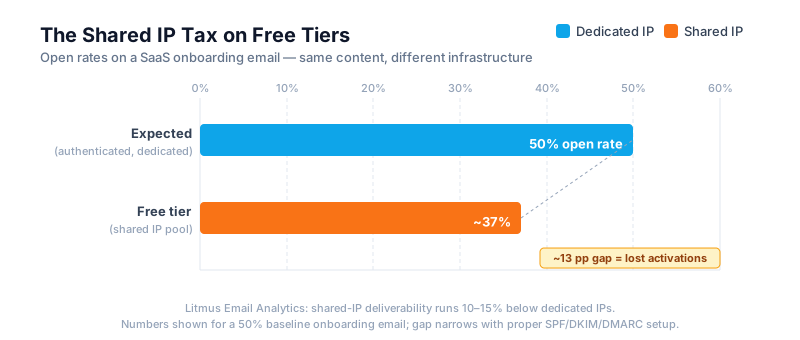
Every free-tier user shares IP addresses with other free-tier users. Some of those users are spammers. Litmus Email Analytics data puts deliverability on shared IPs at 10-15% lower than dedicated IPs. That's the difference between a 45% open rate and a 30% open rate on your onboarding emails.
The question isn't whether shared IPs are worse — they are. The question is whether the platform actively monitors and cleans their shared pools.
Forced branding
"Sent with [Platform Name]" in your email footer isn't just ugly. It signals to recipients that you're running a scrappy operation. For B2B SaaS, this matters. For a consumer newsletter, probably less so. Some platforms let you remove branding on free plans. Most don't.
Support at 2am
When your transactional emails stop sending during a product launch, you need help immediately. Free-tier support is typically email-only with 24-48 hour response times. Know this going in.
Tier-by-tier breakdown: the platforms worth your attention in 2026
| Platform | Free contacts | Monthly sends | Automation | Branding removable | Best for |
|---|---|---|---|---|---|
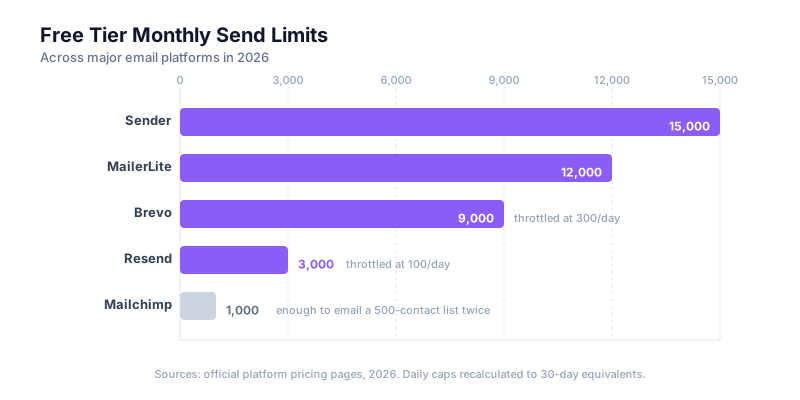
| Brevo | Unlimited | 9,000 (300/day cap) | Basic workflows | No | Transactional + marketing in one |
| MailerLite | 1,000 | 12,000 | Multi-step workflows | No | SaaS automation under 1k users |
| Mailchimp | 500 | 1,000 | None | No | Skip — onboarding funnel for paid |
| Resend | — (API keyed) | 3,000 (100/day cap) | API only | N/A | Developer-led transactional |
| Loops | 1,000 | Plan-based | SaaS-specific triggers | No | Lifecycle email for SaaS |
| Sender | 2,500 | 15,000 | Yes | No | Highest volume on a budget |
Brevo (formerly Sendinblue): the daily-limit workaround
Brevo's free plan allows 300 emails per day with unlimited contact storage. That's 9,000 emails per month if you max it out daily. The catch: you can't burst-send a campaign to 2,000 people at once. Everything gets throttled across the day.
For SaaS teams, this is actually fine. Transactional emails (password resets, receipts, notifications) trickle in throughout the day anyway. Onboarding sequences fire per-user, not all at once. The daily cap only hurts if you're doing large broadcast campaigns — which, at the early stage, you probably shouldn't be.
Automation is included on the free plan, though limited to basic workflows. Transactional email free tier support is solid here — Brevo handles both marketing and transactional from one platform.
Verdict: Best all-rounder for bootstrapped SaaS teams who need both transactional and marketing email without paying.
Mailchimp: the fallen standard
500 contacts. 1,000 sends per month. No automation. No A/B testing. Mailchimp branding on every email. The Mailchimp free plan 2026 is a shadow of what it was.
If you already have more than 500 email subscribers — which happens in week two for most SaaS launches with any traction — this plan is useless on day one. Mailchimp is banking on brand recognition to get you in the door, then converting you to their $13/month Essentials plan immediately.
Verdict: Skip it. The free tier exists to sell you the paid tier, not to help you grow.
MailerLite: the quiet winner
MailerLite's free plan includes up to 1,000 subscribers, 12,000 emails per month, and — critically — automation workflows. Per MailerLite's published plan comparison, you get access to multi-step automation sequences, landing pages, and a drag-and-drop editor on the free tier.
Twelve thousand sends across 1,000 subscribers means you can run a 5-email onboarding sequence, a weekly newsletter, and still have headroom for product announcements. That's a real email marketing operation, not a demo.
The limitations: MailerLite branding stays on, no A/B testing for subject lines, and no advanced segmentation. But for a pre-revenue SaaS? This is more than enough.
Verdict: Best free tier for SaaS teams that need automation without paying. Period.
Resend: the developer's transactional pick
Resend is API-first, built for developers who want to send transactional email without wrestling with SMTP configuration or marketing-platform bloat. Their free tier offers 3,000 emails per month and 100 emails per day.
No drag-and-drop editor. No visual automation builder. This is for teams that want to send password resets, receipt emails, and notification emails via API calls from their codebase. If that's your use case, Resend is cleaner and faster to implement than Brevo or Mailchimp's transactional APIs.
Verdict: Best for developer-led teams who only need transactional email and want to stay in code.
Loops: built for SaaS, marketed to SaaS
Loops.so positions its free tier explicitly for pre-launch and early-stage SaaS teams (confirmed via their pricing page). You get 1,000 contacts and basic automation designed around SaaS use cases: onboarding flows, trial expiration sequences, feature announcements.
The product feels opinionated in a good way — it's not trying to be everything for everyone. The templates, the workflow builder, and the event-based triggers are all designed around the "user signed up → user activated → user converted" funnel that SaaS teams actually care about.
Verdict: Best purpose-built option if you're specifically doing SaaS onboarding and lifecycle email.
Underdogs: Sender and Moosend
Sender offers 2,500 subscribers and 15,000 emails per month on their free plan, with automation included. That's one of the most generous email marketing free plan limits in the market. The trade-off is less brand recognition and a smaller community for troubleshooting.
Moosend previously offered a free plan but has shifted toward a 30-day free trial model. Verify their current pricing before committing — this is a case where "free tier" language on affiliate sites may be outdated.
The deliverability reality check for free accounts
Shared IP pools: the invisible tax
When you send from a free tier, your emails leave from the same IP addresses as thousands of other free users. If those users have poor list hygiene or send spammy content, the IP reputation drops — and your emails land in spam folders alongside theirs.
This isn't theoretical. Litmus research puts shared IP deliverability at 10-15% below dedicated IPs on average. For a SaaS onboarding email with a 50% expected open rate, that could mean 35-40% actual opens. Those are users who never see your getting-started guide, never activate, and never convert.
Authentication setup on free plans
The good news: most platforms in 2026 allow SPF, DKIM, and DMARC configuration on free tiers. Brevo, MailerLite, Loops, and Resend all let you authenticate your sending domain without upgrading. This is table stakes — if a platform doesn't let you set up domain authentication on their free plan, walk away.
Domain warm-up
If you're sending from a brand-new domain, you need to gradually increase volume to build sender reputation. Most platforms don't offer explicit warm-up tools on free plans, but the natural constraint of low send limits actually helps here. Brevo's 300/day cap, for example, forces a gradual ramp-up that mimics proper warm-up behavior.
Real-world benchmarks
Free-tier senders typically see open rates 5-8% below the platform's published averages. This gap narrows once you authenticate your domain and maintain clean lists. The platform matters less than your hygiene practices — but starting on a platform with well-maintained shared IPs (Brevo and MailerLite are both known for this) gives you a head start.
The hidden upgrade triggers: when free stops working
Here's a scenario that plays out constantly: You launch your SaaS. You set up a 3-email onboarding sequence on MailerLite's free plan. It works great for three months. Then you realize you need:
- A branching sequence based on whether users completed setup
- A/B testing on your subject lines because open rates are declining
- Segmentation by plan type so trial users get different messaging than free users
- More than 1,000 contacts because you just got featured on Product Hunt
Each of these is a paid-tier feature on most platforms. The moment your email strategy needs conditional logic, you've outgrown most free tiers.
The mid-campaign ceiling
The worst version of this: you're halfway through sending a product launch announcement to 900 contacts. You hit your monthly send limit at contact #600. Three hundred people get the email tomorrow (or never, if you don't notice). Your launch analytics are garbage. Your urgency-based CTA ("24 hours only!") is now a lie for a third of your list.
Prevention: Always check your remaining sends before queuing a broadcast. Better yet, pick a platform where your normal sending patterns use less than 60% of the monthly cap, giving you burst capacity for launches.
Recommended stack by use case
Pure transactional email (receipts, password resets, notifications)
Resend if your team is developer-led and wants API control. Brevo if you want a single platform that can grow into marketing email later.
SaaS onboarding sequences under 1,000 users
MailerLite for the most generous automation-included free tier. Loops if you want a product specifically designed for SaaS lifecycle email and don't mind a newer platform.
Newsletter + marketing hybrid
Brevo for unlimited contacts with daily send throttling. Sender if you need higher monthly volume and don't mind a less polished UI.
Developer-led teams who want full control
Resend for transactional. Pair it with MailerLite or Loops for marketing sequences. Keep them separate — transactional email should never share infrastructure with marketing email anyway.
How to migrate off free without burning your list
Portability matters from day one
Before you commit to any platform, verify that you can export your full contact list — with tags, custom fields, and engagement data — as a CSV. MailerLite and Brevo both make this straightforward. Some platforms, particularly those with proprietary contact scoring, make exports painful or strip metadata.
Also check: can you export your automation workflows, or will you rebuild them from scratch? Most platforms don't offer workflow export. Assume you'll be rebuilding, and keep your sequence logic documented externally.
When to upgrade: the signals
- You're consistently using more than 70% of your send limit
- You need branching automation that the free tier doesn't support
- Your list is approaching the contact cap and you're growing 10%+ monthly
- You're sending time-sensitive campaigns and can't risk hitting a ceiling mid-send
Negotiate before you pay full price
Most major ESPs offer startup credits or discounted first-year pricing if you ask. Brevo, Mailchimp, and MailerLite all have startup programs. Resend offers increased free-tier limits for open-source projects. Email their sales team before clicking "upgrade" on the pricing page. The worst they can say is no, and the typical discount is 25-50% off your first year.
What to do right now
If you're currently on Mailchimp's free plan and feeling the squeeze, migrate to MailerLite this week. The free tier is better in every dimension that matters for SaaS: more contacts, more sends, automation included.
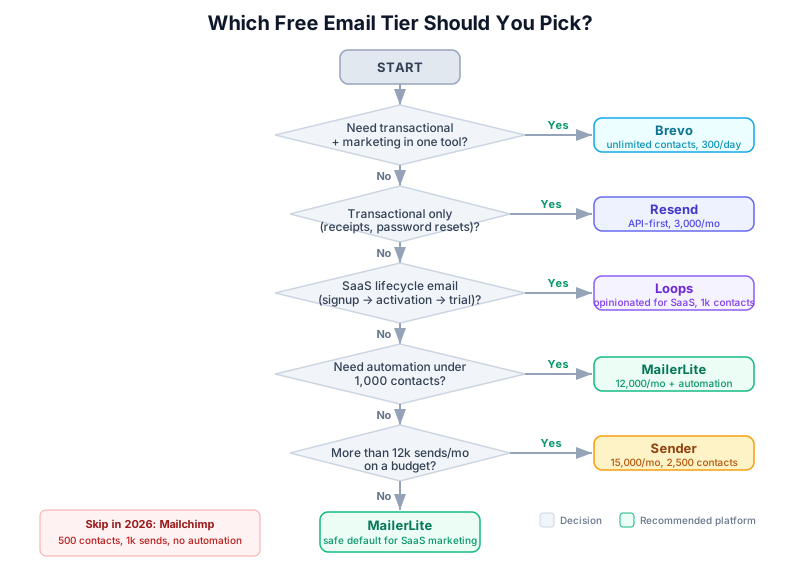
If you haven't picked a platform yet, start with this decision: Do you need transactional email, marketing email, or both? If both, start with Brevo. If transactional only, start with Resend. If marketing only with automation, start with MailerLite.
Then authenticate your domain immediately (SPF + DKIM + DMARC), keep your list clean from day one, and don't wait until you hit the ceiling to plan your upgrade path. The best time to evaluate your next platform is when you're at 50% of your limits — not 100%.
Pick the sending emails service free tier that's designed to help you grow, not the one designed to make you feel stuck. The difference is obvious once you know what to look for.